The US Food and Drug Administration (FDA) appears to have halted its domestic inspections of pharmaceutical facilities, although not before attempting to inspect a contract development and manufacturing organization (CDMO) on Monday and subsequently deciding to end the inspection early and announce the halt.
The CEO of the CDMO, who requested that he and his firm remain anonymous, explained to Focus via email how his company received a last-minute inspection request from an FDA inspector whose planned trip for inspections in Europe was canceled.
Last Friday afternoon, the inspector allegedly called the CDMO to say he would be coming in for a post-approval inspection on two generic drugs. The CEO said he did not understand the need for the inspection as the site had received a pre-approval inspection and general inspection in January 2019, so the company did not expect another inspection for two or three years.
But the FDA inspector arrived alone on Monday morning, the CEO said, and the company firmly expressed its opposition to the inspection at that time as it could put himself and about 15 company employees at risk due to COVID-19. The CEO noted that there did not appear to be a need for the post-approval inspection of these generics as there were no in-market issues or complaints, nor was there a convincing need for a general systems inspection.
Nevertheless, the inspector performed the inspection for between two and three hours and then received a phone call to end the inspection, and he verbally told the CDMO that FDA is suspending all domestic inspections.
Another US-based CDMO that also sought to remain anonymous told Focus that it was contacted Monday about the need for a brief FDA visit on Tuesday, but that was subsequently canceled.
FDA has not responded to a request for comment on the halt to domestic inspections but this story will be updated when it does.
FDA Drafts Guidance on Restricted Delivery Systems for Liquid Drugs
In an effort to reduce the incidence of accidental drug ingestion by children, the US Food and Drug Administration (FDA) on Tuesday issued draft guidance detailing considerations for when drugmakers should employ restricted delivery systems for oral liquid drugs.
Despite advancements in other forms of child-resistant packaging, such as blister packaging and safety caps, FDA says that accidental ingestion of oral liquid drugs accounts for nearly 10,000 emergency department visits annually by children under six.
Specifically, the 10-page draft guidance provides recommendations for when restricted delivery systems should be considered, as well as human factors and design considerations and directions for use for products that feature restricted delivery systems. The guidance also describes two types of flow restrictors that could be used based on product characteristics, closed flow and open flow restrictors.
Closed flow restrictors are meant to limit access to a single-unit volume using a self-closing valve, whereas open flow restrictors allow for a “continuous, controlled volume.”
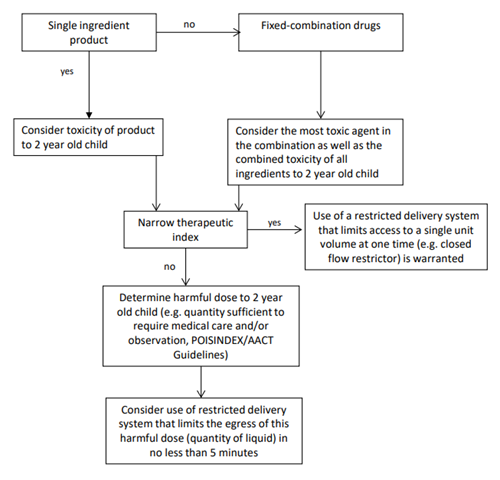
According to FDA, the target for restricted delivery systems should be to “reduce the amount of liquid that flows from a bottle in a 5-minute period based on the toxic dose of the drug product to a 2 year-old child.” More specifically, FDA says companies should use the 50th percentile weight for toxic dose calculations according to the Center for Disease Control and Prevention’s growth charts.
FDA says that drugmakers should consider closed flow restrictors for narrow therapeutic index drugs and drugs “with significant toxicities at doses that are close to the therapeutic dose,” such as acetaminophen.
The guidance features a flowchart to help drugmakers decide whether a restricted delivery system should be considered for their product.
The guidance also provides specific recommendations for products containing one or more of five active pharmaceutical ingredients: acetaminophen, dextromethorphan, diphenhydramine, ibuprofen and pseudoephedrine, which account for most emergency department visits for children involving over-the-counter (OTC) liquid medications. For each ingredient, FDA provides a maximum deliverable quantity within a 5-minute interval.
Check on FDA
Despite advancements in other forms of child-resistant packaging, such as blister packaging and safety caps, FDA says that accidental ingestion of oral liquid drugs accounts for nearly 10,000 emergency department visits annually by children under six.
Specifically, the 10-page draft guidance provides recommendations for when restricted delivery systems should be considered, as well as human factors and design considerations and directions for use for products that feature restricted delivery systems. The guidance also describes two types of flow restrictors that could be used based on product characteristics, closed flow and open flow restrictors.
Closed flow restrictors are meant to limit access to a single-unit volume using a self-closing valve, whereas open flow restrictors allow for a “continuous, controlled volume.”
According to FDA, the target for restricted delivery systems should be to “reduce the amount of liquid that flows from a bottle in a 5-minute period based on the toxic dose of the drug product to a 2 year-old child.” More specifically, FDA says companies should use the 50th percentile weight for toxic dose calculations according to the Center for Disease Control and Prevention’s growth charts.
FDA says that drugmakers should consider closed flow restrictors for narrow therapeutic index drugs and drugs “with significant toxicities at doses that are close to the therapeutic dose,” such as acetaminophen.
The guidance features a flowchart to help drugmakers decide whether a restricted delivery system should be considered for their product.
The guidance also provides specific recommendations for products containing one or more of five active pharmaceutical ingredients: acetaminophen, dextromethorphan, diphenhydramine, ibuprofen and pseudoephedrine, which account for most emergency department visits for children involving over-the-counter (OTC) liquid medications. For each ingredient, FDA provides a maximum deliverable quantity within a 5-minute interval.
Check on FDA
Q3D(R1) Elemental Impurities Guidance for Industry
Elemental impurities in drug products may arise from several sources; they may be residual catalysts that were added intentionally in synthesis or may be present as impurities (e.g., through interactions with processing equipment or container/closure systems or by being present in components of the drug product). Because elemental impurities do not provide any therapeutic benefit to the patient, their levels in the drug product should be controlled within acceptable limits. There are three parts of this guidance:
• The evaluation of the toxicity data for potential elemental impurities
• The establishment of a permitted daily exposure (PDE) for each element of toxicological concern
• The application of a risk-based approach to control elemental impurities in drug products
• The evaluation of the toxicity data for potential elemental impurities
• The establishment of a permitted daily exposure (PDE) for each element of toxicological concern
• The application of a risk-based approach to control elemental impurities in drug products
Subscribe to:
Posts (Atom)