Product Recalls, Including Removals and Corrections
This guidance document is intended to provide guidance and recommendations to FDA regulated industry regarding what information firms should give to the Food and Drug Administration (FDA) and how they should notify their customers about product recalls. This guidance is intended to assist those members of industry regulated by the FDA in handling most aspects of a product recall, as well as some removals and corrections which do not meet the definition of a recall under 21 CFR 7.3. The guidance includes a checklist of documentation and information that the industry can provide to the FDA that will be used by the FDA to evaluate, classify, monitor and audit product recalls. Various statutory provisions and regulations, described below, authorize the FDA to require recalls of certain products in particular circumstances. Additionally, subpart C of part 7 of FDA regulations (21 CFR 7.40-59) provides general guidance for the voluntary recall of products, including those recalls initiated by a firm on its own and at the FDA's request. This guidance provides more specific recommendations and applies to voluntary and, to the extent that the guidance does not conflict with statute or regulation, mandatory recalls of all FDA-regulated products (i.e., food, including animal food; drugs, including animal drugs; medical and radiological devices and products; cosmetics; tobacco products; and biological products.)
FDA has Halted Domestic Pharma Inspections
The US Food and Drug Administration (FDA) appears to have halted its domestic inspections of pharmaceutical facilities, although not before attempting to inspect a contract development and manufacturing organization (CDMO) on Monday and subsequently deciding to end the inspection early and announce the halt.
The CEO of the CDMO, who requested that he and his firm remain anonymous, explained to Focus via email how his company received a last-minute inspection request from an FDA inspector whose planned trip for inspections in Europe was canceled.
Last Friday afternoon, the inspector allegedly called the CDMO to say he would be coming in for a post-approval inspection on two generic drugs. The CEO said he did not understand the need for the inspection as the site had received a pre-approval inspection and general inspection in January 2019, so the company did not expect another inspection for two or three years.
But the FDA inspector arrived alone on Monday morning, the CEO said, and the company firmly expressed its opposition to the inspection at that time as it could put himself and about 15 company employees at risk due to COVID-19. The CEO noted that there did not appear to be a need for the post-approval inspection of these generics as there were no in-market issues or complaints, nor was there a convincing need for a general systems inspection.
Nevertheless, the inspector performed the inspection for between two and three hours and then received a phone call to end the inspection, and he verbally told the CDMO that FDA is suspending all domestic inspections.
Another US-based CDMO that also sought to remain anonymous told Focus that it was contacted Monday about the need for a brief FDA visit on Tuesday, but that was subsequently canceled.
FDA has not responded to a request for comment on the halt to domestic inspections but this story will be updated when it does.
FDA Drafts Guidance on Restricted Delivery Systems for Liquid Drugs
In an effort to reduce the incidence of accidental drug ingestion by children, the US Food and Drug Administration (FDA) on Tuesday issued draft guidance detailing considerations for when drugmakers should employ restricted delivery systems for oral liquid drugs.
Despite advancements in other forms of child-resistant packaging, such as blister packaging and safety caps, FDA says that accidental ingestion of oral liquid drugs accounts for nearly 10,000 emergency department visits annually by children under six.
Specifically, the 10-page draft guidance provides recommendations for when restricted delivery systems should be considered, as well as human factors and design considerations and directions for use for products that feature restricted delivery systems. The guidance also describes two types of flow restrictors that could be used based on product characteristics, closed flow and open flow restrictors.
Closed flow restrictors are meant to limit access to a single-unit volume using a self-closing valve, whereas open flow restrictors allow for a “continuous, controlled volume.”
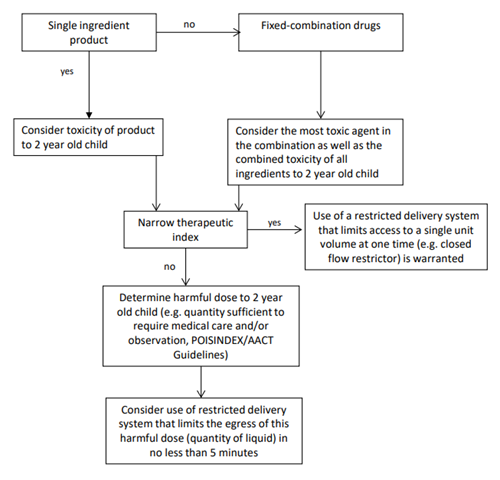
According to FDA, the target for restricted delivery systems should be to “reduce the amount of liquid that flows from a bottle in a 5-minute period based on the toxic dose of the drug product to a 2 year-old child.” More specifically, FDA says companies should use the 50th percentile weight for toxic dose calculations according to the Center for Disease Control and Prevention’s growth charts.
FDA says that drugmakers should consider closed flow restrictors for narrow therapeutic index drugs and drugs “with significant toxicities at doses that are close to the therapeutic dose,” such as acetaminophen.
The guidance features a flowchart to help drugmakers decide whether a restricted delivery system should be considered for their product.
The guidance also provides specific recommendations for products containing one or more of five active pharmaceutical ingredients: acetaminophen, dextromethorphan, diphenhydramine, ibuprofen and pseudoephedrine, which account for most emergency department visits for children involving over-the-counter (OTC) liquid medications. For each ingredient, FDA provides a maximum deliverable quantity within a 5-minute interval.
Check on FDA
Despite advancements in other forms of child-resistant packaging, such as blister packaging and safety caps, FDA says that accidental ingestion of oral liquid drugs accounts for nearly 10,000 emergency department visits annually by children under six.
Specifically, the 10-page draft guidance provides recommendations for when restricted delivery systems should be considered, as well as human factors and design considerations and directions for use for products that feature restricted delivery systems. The guidance also describes two types of flow restrictors that could be used based on product characteristics, closed flow and open flow restrictors.
Closed flow restrictors are meant to limit access to a single-unit volume using a self-closing valve, whereas open flow restrictors allow for a “continuous, controlled volume.”
According to FDA, the target for restricted delivery systems should be to “reduce the amount of liquid that flows from a bottle in a 5-minute period based on the toxic dose of the drug product to a 2 year-old child.” More specifically, FDA says companies should use the 50th percentile weight for toxic dose calculations according to the Center for Disease Control and Prevention’s growth charts.
FDA says that drugmakers should consider closed flow restrictors for narrow therapeutic index drugs and drugs “with significant toxicities at doses that are close to the therapeutic dose,” such as acetaminophen.
The guidance features a flowchart to help drugmakers decide whether a restricted delivery system should be considered for their product.
The guidance also provides specific recommendations for products containing one or more of five active pharmaceutical ingredients: acetaminophen, dextromethorphan, diphenhydramine, ibuprofen and pseudoephedrine, which account for most emergency department visits for children involving over-the-counter (OTC) liquid medications. For each ingredient, FDA provides a maximum deliverable quantity within a 5-minute interval.
Check on FDA
Q3D(R1) Elemental Impurities Guidance for Industry
Elemental impurities in drug products may arise from several sources; they may be residual catalysts that were added intentionally in synthesis or may be present as impurities (e.g., through interactions with processing equipment or container/closure systems or by being present in components of the drug product). Because elemental impurities do not provide any therapeutic benefit to the patient, their levels in the drug product should be controlled within acceptable limits. There are three parts of this guidance:
• The evaluation of the toxicity data for potential elemental impurities
• The establishment of a permitted daily exposure (PDE) for each element of toxicological concern
• The application of a risk-based approach to control elemental impurities in drug products
• The evaluation of the toxicity data for potential elemental impurities
• The establishment of a permitted daily exposure (PDE) for each element of toxicological concern
• The application of a risk-based approach to control elemental impurities in drug products
Providing Regulatory Submissions in Electronic Format — Certain Human Pharmaceutical Product Applications and Related Submissions Using the eCTD Specifications Guidance for Industry
Under section 745A(a) of the Federal Food, Drug, and Cosmetic Act (FD&C Act), at least 24 months after the issuance of a final guidance document in which the Food and Drug Administration (FDA or Agency) has specified the electronic format for submitting submission types to the Agency, such content must be submitted electronically and in the format specified by FDA. , This guidance describes how sponsors and applicants must organize the content that they submit to the Agency electronically for all submission types under section 745A(a) of the FD&C Act. This guidance also references several technical specification documents and the Electronic Common Technical Document Conformance (eCTD) Guide, which provide additional details regarding the organization of content for electronic submissions. Under section 745A(a) of the Federal Food, Drug, and Cosmetic Act (FD&C Act), at least 24 months after the issuance of a final guidance document in which the Food and Drug Administration (FDA or Agency) has specified the electronic format for submitting submission types to the Agency, such content must be submitted electronically and in the format specified by FDA. , , This guidance describes how sponsors and applicants must organize the content that they submit to the Agency electronically for all submission types under section 745A(a) of the FD&C Act. This guidance also references several technical specification documents and the Electronic Common Technical Document Conformance (eCTD) Guide, which provide additional details regarding the organization of content for electronic submissions.
FDA Publishes Dataset of CDER Approvals Since 1985
To provide researchers with more accurate and accessible data about historic drug approvals, the US Food and Drug Administration (FDA) on Friday released a dataset containing information about all new drugs and biologics approved by the Center for Drug Evaluation and Research (CDER) dating back to 1985.
“FDA created the compilation to facilitate data accessibility, transparency, and accuracy when researchers seek information about an approved drug,” FDA writes, adding that the compilation should accurately reflect “the state of each application at the time of initial regulatory approval.”
The compilation itself is a downloadable .CSV file containing information on more than 1,000 new molecular entities (NMEs) and new biologics approved from 1 January 1985 through 31 December 2019.
For each product, the spreadsheet provides the proprietary name, active ingredient/moiety, applicant, application type, application number, dosage form, route of administration, receipt and approval dates, approved indications and uses, designations and whether a priority review voucher was issued or redeemed for the application.
Because the compilation is intended to provide information about products at the time of their original approval, some information, such as supplemental indications granted after the initial approval, are not included.
The agency says it will update the compilation periodically with new approval data, and asks that feedback and corrections be send to CDER.NMENewBiologicApprovals@fda.hhs.gov.
FDA has also published a “data dictionary” to accompany the compilation that provides a definition of each field included in the spreadsheet.
Read Details
FDA Finalizes eCTD Guidance, Consults on eCTD v4.0 Technical Documents
The US Food and Drug Administration (FDA) on Friday finalized the seventh revision to its guidance on making regulatory submissions in electronic common technical document (eCTD) format to specify cases where an exemption or waiver from eCTD requirements is warranted.
The 17-page guidance finalizes a draft version released in July 2019 and replaces the previous final version from January 2019.
Within the guidance, FDA says it will exempt all Type III drug master files (DMFs) from eCTD requirements, in addition to noncommercial investigational new drugs (INDs).
The final guidance also clarifies that certain positron emission tomography (PET) drugs and Type II DMFs for PET drugs may qualify for a long-term waiver from eCTD requirements. Additionally, the final guidance explains the “unique and rare” circumstances in which the agency will grant short-term waivers from eCTD requirements, including events “beyond the control of the submitter,” such as natural disasters or malware attacks.
FDA also opened a public consultation on Friday for two eCTD technical documents, the eCTD v4.0 Technical Conformance Guidance and the FDA eCTD v4.0 Module 1 Implementation Package.
The eCTD Technical Conformance Guide is meant to provide drugmakers with “specification, recommendations, and general considerations” for filing eCTD v4.0-based submissions with the Center for Drug Evaluation and Research (CDER) and Center for Biologics Evaluation and Research (CBER) using either the International Council for Harmonisation or FDA implementation packages.
FDA says it is looking for comments to ensure the “accuracy, suitability, and appropriateness of these specifications for the submission of eCTD v4.0 submissions,” and notes that the documents are not meant for implementation at this time and that the agency will “only accept eCTD v3.2.2 submissions” until v4.0 is finalized.
Read on FDA website
Subscribe to:
Posts (Atom)